Player Archetypes in Mobile Games: How to Map Emotions to High-Converting Ad Creatives
Quick gut check.
When you look at your last 10 ads, do they all feel like slight variations of the same gameplay moment? And is coming up with new testable ideas getting harder every sprint?
If yes, you’re not alone, and this post is for you.
We study hundreds of game ads every month and a common observable pattern - most game teams are treating UA ads like fireworks. They’re flashy, they grab attention for a split second, but they usually have zero connection to why people actually play the game.
So, what are UA Ads at the core if not attention grabbers?
Ads are quite literally the "sneak peek" of an emotional promise. Before someone ever downloads your game, your ad is already answering one question in their head: “How will this make me feel?”
To get that right, you have to stop looking at data points and start looking at player archetypes. You need to map who the player is to how the ad feels.
People don't play for the same reasons. Period.
Every player comes in with a different motivation. A different emotional need. Some play to win. Some play to explore. Others just want five quiet minutes at the end of a long day. These “whys” are emotional drivers and emotions convert far better than mechanics ever will. When you map player archetypes to emotional triggers, your ads naturally start to feel more relevant, more personal, and more effective.
This is also exactly why User Acquisition teams cannot afford to work separately from game designers.
The highest-performing UA creatives are not invented in brainstorm rooms or pulled from trend decks - they are extracted from game design psychology. Game designers spend months researching player motivation, emotional loops, progression systems, and friction points that drive retention. When UA teams collaborate closely with them, creatives stop being surface-level gameplay demos and start reflecting the real emotional payoff of the game. This alignment leads to more honest ads, higher-quality installs, stronger Day-1 and Day-7 retention, and ultimately better ROAS. If UA ignores game design research, creatives might win the click, but they will almost always lose the player.
So what does this all look like in practice?
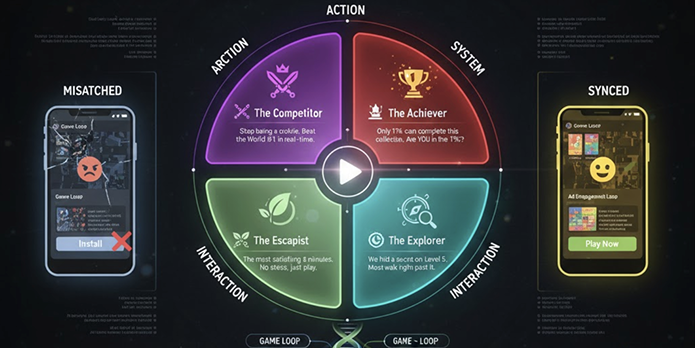
Let’s break down a few classic player archetypes and how each one completely changes the vibe of an ad.
The Achiever (Chasing Progress & Mastery)
Achievers live for progress bars, milestones, and that satisfying Level Up moment.
Ad hook:
“Think you can hit Level 20 without losing a life?” Emotional trigger: Pride, mastery, achievement
These players respond to ads that challenge their skill and showcase visible progress.
The Explorer (Driven by Curiosity)
Explorers aren’t rushing to finish. They want to discover what’s hidden, what’s different, what’s unexplored.
Ad hook:
“What happens if you take the path on the left?” Emotional trigger: Curiosity, discovery
For this archetype, mystery and choice outperform raw gameplay mechanics.
The Competitor (Obsessed with Winning)
Competitors don’t just want to play, they want to prove they’re better than everyone else.
Ad hook:
“Only 2% of players can actually beat this.” Emotional trigger: Tension, ego, challenge
Social comparison, scarcity, and difficulty indicators work especially well here.
The Escapist (Seeking Calm & Comfort)
Escapists use games as a break from noise, pressure, and chaos.
Ad hook:
“Your little escape from the chaos.” Emotional trigger: Relaxation, comfort, control
For this user, soft pacing, soothing visuals, and emotional safety matter more than speed or difficulty.
Why Does This Matter for UA Creatives
When you know who you’re talking to, your ads stop feeling like shots in the dark. Instead, they become a direct emotional line to a specific player, speaking to their motivation, their mood, and their reason for installing in the first place.
That’s when UA creatives stop being just “ads” and start becoming conversion machines built on player psychology.
Grand Takeaway *Drumroll*
Stop Testing Formats. Start Testing Feelings.
Most UA teams A/B test formats.Live action vs animation. UGC vs gameplay. Portrait vs landscape.
That’s not wrong - it’s just incomplete.
The real opportunity is in testing emotional hypotheses.
Instead of asking “Which format wins?”, start asking:
- Does a pride-driven creative outperform a curiosity-driven one at this stage of the funnel?
- Do players respond more to the stress of a ticking timer or the relief of a clean win?
- Is this audience motivated by mastery, competition, or calm?
When you test this way, you’re not just chasing a higher CTR or IPM. You’re learning what actually makes your audience feel something, and that insight compounds across every future creative you build. This emotion-first testing mindset is a big part of how we approach UA creatives at HapHat. We don’t just test what looks different - we test what feels different.
The Trust Factor: Emotional Consistency = Retention
This is where most UA strategies quietly break.
If your ad promises a high-stakes, adrenaline-fueled experience - but the game opens with a slow, 10-minute tutorial, the player immediately feels misled. They might install, but they won’t stay. That gap between ad emotion and early gameplay emotion kills retention.
At HapHat, we think of UA creatives as contracts with the player. Break that contract, and no amount of optimization will save your Day-1 or Day-7 retention.
A better way to organize your library
Here’s a simple shift that changes everything. Instead of tagging your creatives as UGC, Gameplay, or Animation, try tagging them by the primary emotion they trigger:
- 🏆 Pride / Achievement
- 🌿 Calm / Relaxation
- 🕵️ Curiosity / Mystery
- ⚔️ Tension / Competition
This emotional tagging system makes creative scaling far more intentional. It allows UA teams, designers, and strategists to quickly identify what’s working - and why it’s working - across genres, markets, and channels.
This is exactly how we at HapHat help teams move from guesswork to repeatable creative systems rooted in player psychology.
The Bottom Line
When you stop seeing your audience as faceless segments and start seeing them as players with real emotional needs, everything changes.
At HapHat, this bridge is built deliberately by our team that understands game design psychology, UA performance metrics, creative production, and AI-driven iteration as one connected system, not separate functions. We don’t just ask what will get the click; we ask what will keep the player. That means translating player motivation, progression loops, and emotional payoffs into creatives that are scalable, testable, and honest.
If you’re building your next wave of UA creatives and want them grounded in real player motivation, you know where to find us.
hello@haphatstudio.com