What Game Loops Can Teach Us About UA Ad Engagement Loops
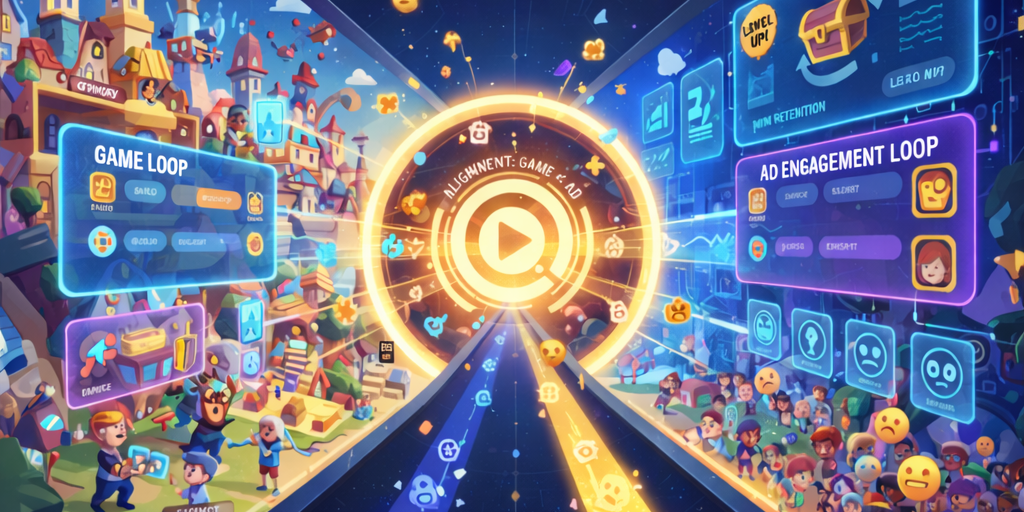
User acquisition for games has never been more competitive. CPIs are volatile, platforms are crowded, and attention spans are shrinking by the day. If you’ve spent any time running UA ads, you’ve likely experienced the same painful cycle: the installs come in, dashboards look healthy, but retention falls off a cliff. Players open the app once, maybe twice, and then disappear. The players are "dead on arrival." When this happens at scale, the issue is rarely the targeting or the bid strategy alone.
The reason is usually pretty simple, even if it’s hard to hear: The ad promised a vibe that the game didn't deliver.
The industry is currently grappling with a "Retention Recession." We’ve perfected the art of the click, but we are failing at the art of the stay. The reason is a fundamental disconnect between the Game Loop (what the player does) and the Ad Engagement Loop (what the player expects).
This mismatch between expectation and reality is where most ad strategies quietly fail. And the solution isn’t more aggressive hooks or louder creatives. It’s understanding something game designers have obsessed over for decades: the core loop.
It’s all about the Core Loop: The Heartbeat of Every Game
Every successful game has a "rhythm", which is a core loop that keeps people coming back.
- Puzzle games: Solve → Get Reward → Upgrade → Repeat.
- Strategy games: Build → Fight → Collect → Expand.
- Idle games: Wait → Collect → Boost → Accelerate → Repeat
But core loops aren’t just about mechanics. They are emotional systems.
A well-designed loop takes players through micro-cycles of:
- Tension or curiosity
- Challenge or anticipation
- Resolution
- Reward and relief
This emotional cadence is what makes players say, “One more level,” even when they planned to quit ten minutes ago.
The problem? Most ads completely ignore this emotional DNA.
Ads Are Loops Too (Even If We Don’t Treat Them That Way)
An ad is not a single event. It’s the first step in a longer engagement journey:
- The user notices the ad
- They feel curiosity, tension, or desire
- They take action (click or swipe)
- They expect a specific payoff inside the product
This is an engagement loop.
When that loop breaks, when the payoff doesn’t match the promise - users don’t just churn. They disengage emotionally. The install might still count, but trust is already lost. This is why so many campaigns generate volume but fail to scale sustainably. The ad loop and the game loop are telling two different stories.
Think of ads like trailers, not Click-bait traps
In the race for a low CPI, it’s tempting to use flashy effects or trending hooks that grab attention in those first three seconds. But if those hooks don't represent the actual experience, your retention will crater. The ad may highlight chaos, speed, or dominance, while the actual game is methodical and strategic. Or the ad may focus on impossible fails, while the game rewards patience and optimization.
If a player downloads a calm, strategic city-builder because the ad looked like a chaotic war zone, they aren't going to suddenly start loving city-builders. They’re just going to hit "delete."
Clickbait ads create front-loaded engagement followed by immediate disappointment.
The Fix: Align the Ad Loop with the Game Loop
Learning from my years in Game Design: Make the Ad a Mini Core Loop.
Game designers don’t introduce random mechanics without context. They onboard players gradually, teaching them what to expect and rewarding them for understanding the system.
Ads should do the same. The most effective game ads function as compressed versions of the game’s real core loop.
Ask yourself these three questions:
- Does this ad capture the actual essence of the game’s loop?
- Does it trigger the same motivation (mastery, curiosity, competition) that the game does?
- Is it attracting people who actually like this genre?
Emotional Consistency Beats Visual Flash
You have to know who you’re talking to, to understand what emotion to deliver. High-performing ads don’t always look the most impressive. But they feel honest.
Emotional consistency matters more than polish:
- If the game loop is about mastery, the ad should show learning and improvement
- If the game loop is about relaxation, the ad should feel calm and satisfying
- If the game loop is about risk and reward, the ad should show meaningful choices
This isn’t about making your ads more complicated; it’s about making them more honest.
The Bottom Line
The "Loop Alignment Formula" is pretty straightforward:
Game DNA - Emotional Core - Matching Ad Creative - High-Quality Players - Better LTV.
Where Haphat Comes In
As a founder working closely with UA and game teams every day, I’ve seen one pattern repeat itself over and over again: growth breaks the moment creatives drift away from the real game experience.
At Haphat, that insight defines how we build UA creatives. We don’t treat ads as disposable growth hacks, we treat them as the player’s first real interaction with the game loop.
Every creative we produce is designed to honestly reflect gameplay rhythm, emotional pacing, and player motivation. The goal isn’t just to earn a click, but to set the right expectation - so when a player installs, the game feels familiar, intuitive, and worth investing time in.
At the same time, creative ambition has to make business sense. UA creative production ROAS matters. That’s why we’ve built a ROAS-first creative system: rapid testing, modular production, and performance-led iteration that allows teams to move fast without burning budget.
We focus on giving UA teams the most ROAS-efficient, powerful creative production armoury possible.
When ad engagement loops and game loops move in sync, growth becomes predictable instead of fragile. Our role at Haphat is to make that alignment repeatable, at speed, at scale, and with returns that actually hold.
If you’re curious to explore how we work and what it looks like to have Haphat operate as an extension of your creative and UA team, let’s chat on hello@haphatstudio.com or drop us a message on Linkedin.